

Once you can form valid K-Map groups, another question appears: which groups actually belong in the final expression?
A function may contain several valid pairs, quads, or octets. Some can still be enlarged, some are already maximal, and only certain groups are unavoidable.
Prime implicants identify the maximal valid groups worth considering. Essential prime implicants identify the ones the final cover cannot leave out.
What Is an Implicant?
For SOP simplification, an implicant is a product term represented by a valid group of required 1 cells, possibly enlarged with usable don't-care cells.
For example:
A'B
may describe a valid group containing several minterms where the function is 1.
The K-Map shows the cells visually; the implicant is the Boolean term that represents them.
What Is a Prime Implicant?
A prime implicant is a valid implicant that cannot be expanded into a larger valid implicant.
Suppose a pair can combine with another adjacent pair to form a quad. The original pair is not prime because it can still grow.
If a valid group cannot be expanded any further without including an invalid required value, it is prime.
Prime does not mean "largest group anywhere on the map." A pair can be prime if that particular pair cannot expand, even while a separate quad exists elsewhere.
Being prime also does not guarantee that the group appears in the final expression.
For the underlying geometry, see the Karnaugh Map grouping rules.
What Is an Essential Prime Implicant?
An essential prime implicant is a prime implicant that covers at least one required minterm no other prime implicant covers.
That uniquely covered minterm makes the group mandatory.
If the essential prime implicant were removed, that required minterm would have no remaining coverage.
Prime Implicant vs Essential Prime Implicant
| Feature | Prime Implicant | Essential Prime Implicant |
|---|---|---|
| Definition | Cannot be expanded into a larger valid implicant | A prime implicant that uniquely covers at least one required minterm |
| Must appear in final cover? | Not necessarily | Yes |
| Unique minterm required? | No | Yes |
| Role | Candidate group | Mandatory group |
The key relationship is simple:
Every essential prime implicant is a prime implicant.
Not every prime implicant is essential.
How to Find Prime Implicants on a K-Map
- Fill the K-Map correctly.
- Find valid groups of required cells.
- Include wrap-around and overlap where allowed.
- Check whether each group can expand.
- A group that cannot expand into a larger valid implicant is prime.
- A smaller group that can still expand is not a prime implicant.
The same process applies on a 4-variable Karnaugh Map, where wrap-around groups are especially easy to overlook.
How to Find Essential Prime Implicants
After listing all prime implicants, switch your attention from group size to coverage.
List every required minterm and check which prime implicants cover it.
If a minterm appears in only one prime implicant, that prime implicant is essential.
Essential groups should be selected first because they are not optional.
What Is a Prime Implicant Chart?
A prime implicant chart organizes this coverage into a grid.
Columns represent required minterms.
Rows represent prime implicants.
A mark is placed wherever a prime implicant covers a minterm.
If a column contains only one mark, the prime implicant in that row is essential.
This systematic tabular structure is also central to the Quine-McCluskey method, which automates prime implicant generation and coverage analysis.
Worked Example: Finding Prime and Essential Prime Implicants
Consider:
F(A,B,C,D) = Σm(0,1,2,5,6,7,8,9,10,14)
Using a standard 4-variable K-Map, the complete set of prime implicants is:
B'C'coversm0, m1, m8, m9B'D'coversm0, m2, m8, m10CD'coversm2, m6, m10, m14A'C'Dcoversm1, m5A'BDcoversm5, m7A'BCcoversm6, m7
Each of these groups is valid and cannot be expanded into a larger valid implicant.
Now inspect the coverage.
Minterm:
m9
appears only in:
B'C'
Therefore:
B'C'
is essential.
Minterm:
m14
appears only in:
CD'
Therefore:
CD'
is also essential.
Select both essential prime implicants first.
B'C' covers:
m0, m1, m8, m9
CD' covers:
m2, m6, m10, m14
The only required minterms still uncovered are:
m5
m7
The prime implicant:
A'BD
covers both.
Therefore the final minimal SOP is:
F = B'C' + CD' + A'BD
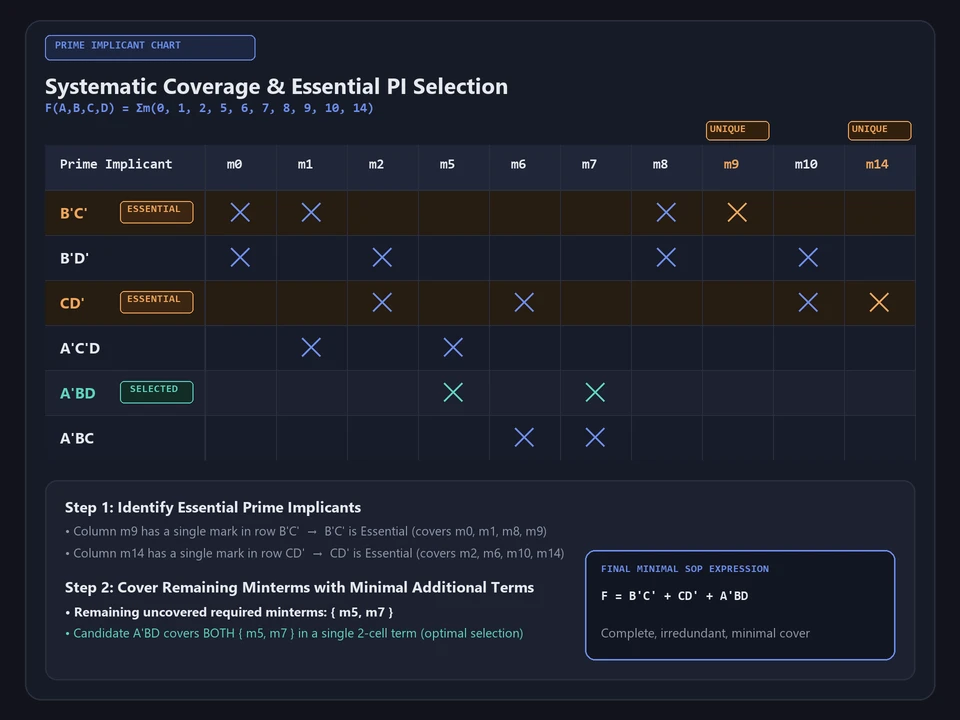
A column with only one coverage mark reveals an essential prime implicant; after the essentials are selected, A'BD covers the remaining m5 and m7.
Why B'D' Is Prime but Not Essential
B'D' covers:
m0, m2, m8, m10
It is prime because the group cannot be expanded into a larger valid implicant.
But it is not essential.
m0 and m8 are also covered by:
B'C'
while m2 and m10 are also covered by:
CD'
No required minterm depends exclusively on B'D'.
That makes it a clean example of a prime implicant that is valid but not mandatory.
Non-Essential Does Not Mean Useless
A'BD is another useful example.
It is not essential at the start because:
m5
and:
m7
are each covered by other prime implicants as well.
After the essential groups are selected, however, m5 and m7 remain uncovered.
A'BD covers both with a single additional term.
So a non-essential prime implicant may still be the best choice for completing the final cover.
Does Every Prime Implicant Go Into the Final Expression?
No.
A function may contain more prime implicants than the final expression needs.
Essential prime implicants are mandatory.
The remaining prime implicants are candidates used only when required to cover cells left after the essentials are selected.
Some functions can also have more than one equally minimal cover.
Prime Implicants and Don’t-Care Values
A don't-care cell may be used to enlarge a valid group.
That can change which prime implicants exist.
The don't-care itself does not need to be covered in the final expression. It is useful only when it helps form a better group containing required cells.
For more detail, see the guide to don't-care conditions in Karnaugh Maps.
Prime Implicants in SOP and POS
The example above uses SOP, where maximal valid groups are formed from required 1s and usable X cells.
For POS, the same grouping idea can be applied to maximal zero-groups, which produce sum terms.
For the broader difference between the two forms, see SOP vs POS in Karnaugh Maps.
Prime Implicants vs Simply Choosing the Biggest Groups
Looking for large groups is useful, but that alone does not finish the problem.
Several prime implicants may overlap.
A valid prime implicant can turn out to be redundant.
Essentiality depends on unique coverage, not visual size.
After the essential groups are selected, the remaining choice depends on which required minterms are still uncovered.
Common Prime Implicant Mistakes
- Calling a group prime even though it can still expand.
- Assuming every prime implicant is essential.
- Including every prime implicant in the final expression.
- Missing wrap-around prime implicants.
- Refusing valid overlap.
- Deciding essentiality from group size instead of unique coverage.
- Treating a don't-care as a required minterm.
- Forgetting to check what remains uncovered after selecting essentials.
- Assuming a Boolean function always has one unique minimal cover.
A Quick Prime Implicant Checklist
- Fill the K-Map correctly.
- Form all maximal valid groups.
- Record the required minterms covered by each group.
- Treat those non-expandable groups as prime implicants.
- Build or inspect the coverage chart.
- Find minterms covered by only one prime implicant.
- Select those prime implicants as essential.
- Mark all required minterms they cover.
- Cover the remaining minterms using an efficient set of other prime implicants.
- Verify the final expression.
How to Verify the Final Cover
Every required minterm must be covered.
For this example:
F = B'C' + CD' + A'BD
covers:
m0, m1, m2, m5, m6, m7, m8, m9, m10, m14
and does not introduce required zero combinations into the SOP function.
You can also compare the manual result with the Karnaugh Map Solver.
Frequently Asked Questions
What is a prime implicant in a K-Map?
A prime implicant is a valid implicant that cannot be expanded into a larger valid implicant.
What is an essential prime implicant?
It is a prime implicant that uniquely covers at least one required minterm, making it mandatory in the final cover.
What is the difference between a prime and an essential prime implicant?
A prime implicant only needs to be non-expandable. An essential prime implicant must also uniquely cover a required minterm.
Does every prime implicant appear in the final answer?
No. Essential prime implicants must appear, while other prime implicants are selected only when needed to cover remaining minterms.
How do you identify an essential prime implicant?
Check the coverage of every required minterm. If a minterm is covered by exactly one prime implicant, that prime implicant is essential.
What is a prime implicant chart?
It is a table with required minterms as columns and prime implicants as rows. Coverage marks show which groups cover which minterms, and a column with only one mark reveals an essential prime implicant.

