

Karnaugh Maps and Quine-McCluskey solve the same basic problem: simplifying a Boolean function into an equivalent expression with fewer terms or literals.
The main difference is the route.
A K-Map turns Boolean adjacency into a visual grouping problem.
Quine-McCluskey turns the same minimization into a systematic tabular procedure.
Neither method changes the function itself. Both are different ways of applying the same Boolean simplification principle.
What Is the Karnaugh Map Method?
A K-Map arranges truth-table outputs in Gray-code order so adjacent cells differ in only one variable.
For SOP, the required 1 cells are grouped into valid pairs, quads, octets, or larger power-of-two groups.
When a variable changes across a group, that variable disappears from the resulting term.
Wrap-around and overlap are both valid when the K-Map adjacency rules allow them.
The main advantage is visual clarity.
For small functions, valid groups can often be recognized quickly.
As the number of variables and possible groupings increases, manual inspection becomes harder.
For the basics, see what a Karnaugh Map is.
What Is the Quine-McCluskey Method?
Quine-McCluskey is a systematic Boolean minimization procedure often called the tabular method.
For a typical SOP problem:
- List the required minterms in binary.
- Group terms by their number of 1 bits.
- Combine compatible terms that differ in exactly one bit.
- Replace the changing bit with a dash.
- Repeat the process until no more valid combinations are possible.
- Collect the non-combinable terms as prime implicants.
- Build a prime implicant chart.
- Select essential prime implicants.
- Cover any minterms that remain.
Don't-care terms may participate in the combination stages when they help create larger implicants.
They do not themselves need to appear as required columns that must be covered in the final chart.
K-Map vs Quine-McCluskey at a Glance
| Feature | Karnaugh Map | Quine-McCluskey |
|---|---|---|
| Approach | Visual grouping of adjacent cells | Systematic binary-term combination |
| Typical workflow | Build map, form valid groups, derive terms | List minterms, combine terms, build PI chart |
| Practical use | Small/manual functions and visual learning | Systematic tabular work and software implementation |
| Prime implicants | Seen as maximal valid groups | Generated by repeated combinations |
| Manual use | Usually intuitive for small maps | Mechanical but more repetitive |
| Computer implementation | Visual grouping is less natural to encode directly | Maps naturally to an algorithm |
| Don't-care support | X cells may enlarge groups | Don't-care terms may join combinations |
| Scaling | Becomes visually difficult as variables increase | Computational workload can grow rapidly |
| Accuracy | Can produce exact minimal forms when solved correctly | Can produce exact minimal forms when the covering stage is solved exactly |
Accuracy is not the main difference.
The difference is how the work is organized.
The Main Difference: Visual Grouping vs Systematic Combining
On a K-Map, adjacency is visible.
In Quine-McCluskey, the same relationship appears as binary terms that differ in exactly one fixed bit.
For example:
0000
and:
0010
differ only in C.
They combine to:
00-0
The dash represents the changing variable.
Using A,B,C,D:
- A = 0 → A'
- B = 0 → B'
- C changes → removed
- D = 0 → D'
Therefore:
00-0 = A'B'D'
The same variable would disappear if the corresponding cells were grouped visually on a K-Map.
Worked Example: Solve the Same Function Both Ways
Consider:
F(A,B,C,D) = Σm(0,2,5,7,8,10,13,15)
K-Map Solution
Use rows AB and columns CD in Gray-code order:
00, 01, 11, 10
The first group is:
m0, m2, m8, m10
These are the four corners.
Across those cells:
- B = 0
- D = 0
while A and C change.
Therefore:
B'D'
The second group is:
m5, m7, m13, m15
This is a normal 2×2 quad.
Across those cells:
- B = 1
- D = 1
while A and C change.
Therefore:
BD
The minimized SOP is:
F = B'D' + BD
For more detail on this layout, see the 4-variable Karnaugh Map guide.
Quine-McCluskey Solution
Use the same minterms in binary:
m0 = 0000m2 = 0010m5 = 0101m7 = 0111m8 = 1000m10 = 1010m13 = 1101m15 = 1111
For the B'D' side:
0000 + 0010 -> 00-00000 + 1000 -> -0000010 + 1010 -> -0101000 + 1010 -> 10-0
The pair implicants can combine again:
00-0 + 10-0 -> -0-0
An equivalent path is:
-000 + -010 -> -0-0
The pattern:
-0-0
means:
- A changes
- B = 0
- C changes
- D = 0
Therefore:
B'D'
Now consider the BD side:
0101 + 0111 -> 01-10101 + 1101 -> -1010111 + 1111 -> -1111101 + 1111 -> 11-1
The next combination gives:
01-1 + 11-1 -> -1-1
or equivalently:
-101 + -111 -> -1-1
The pattern:
-1-1
means:
- A changes
- B = 1
- C changes
- D = 1
Therefore:
BD
Neither:
-0-0
nor:
-1-1
can combine further for this function.
The final prime implicants are:
B'D'
and:
BD
Together they cover every required minterm.
Final result:
F = B'D' + BD
Same Answer, Different Route
The K-Map found:
a four-corner quad
and:
a normal 2×2 quad
Quine-McCluskey found the same simplification by repeatedly combining compatible binary terms.
Both reached:
F = B'D' + BD
The geometry and dash notation represent the same rule: variables that change across a combination disappear.
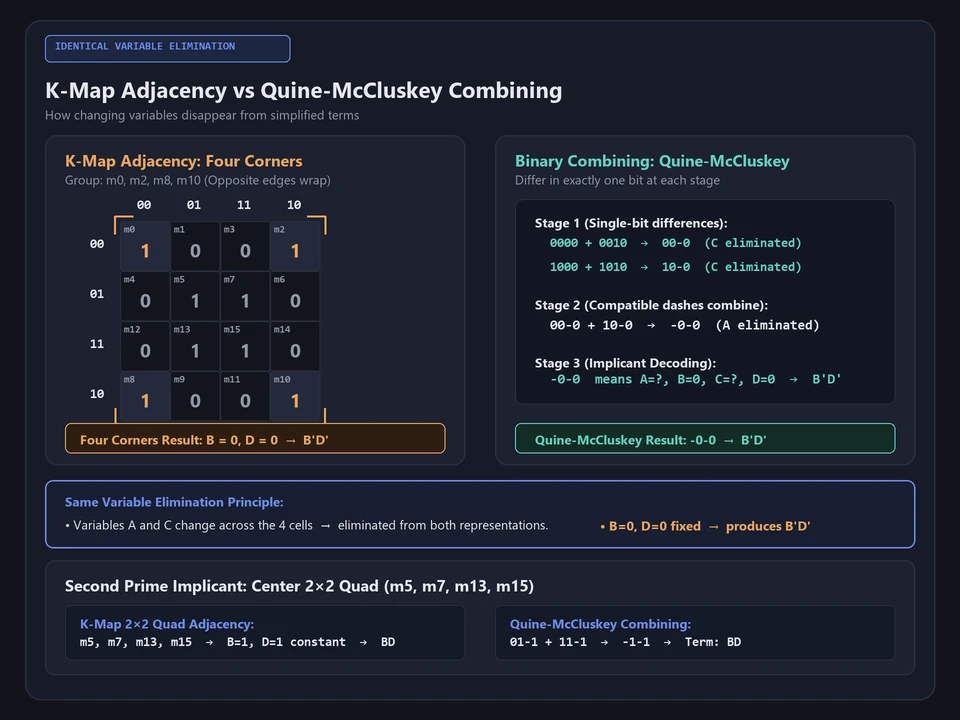
K-Map adjacency and Quine-McCluskey dash patterns express the same rule: variables that change disappear from the simplified term.
Where Do Prime Implicants Fit In?
Both methods ultimately work with the same prime-implicant idea.
On a K-Map, a prime implicant is a valid group that cannot be expanded into a larger valid implicant.
In Quine-McCluskey, it is a combined term that cannot be combined into a larger valid term.
The representation changes.
The underlying idea does not.
For more detail, see prime implicants and essential prime implicants.
Where Does Petrick's Method Fit?
Quine-McCluskey generates prime implicants and the prime implicant chart.
Essential prime implicants may already cover every required minterm.
If they do, the cover-selection problem is finished.
Sometimes, however, required minterms remain and several combinations of non-essential prime implicants could cover them.
Petrick's Method belongs to this cover-selection stage.
It represents the remaining coverage choices algebraically and can determine an exact minimal cover according to the chosen cost criterion.
It is not part of the original binary minterm-combination stage, and it is not required for every function.
Which Method Is Easier by Hand?
For two-, three-, and four-variable functions, many people find a K-Map easier to use manually because the grouping relationships are visible.
Five-variable K-Maps are still possible, but the additional adjacency relationships make manual checking more demanding.
This is a usability issue, not a mathematical limitation.
Which Method Is Better for Software?
Quine-McCluskey maps naturally to a program.
Binary terms can be stored, compared, combined, and placed into a prime implicant chart using systematic rules.
That makes it useful for algorithmic Boolean minimization.
Its workload is not unlimited, though.
The number of implicants and possible cover combinations can grow quickly as the function becomes larger.
For much larger minimization problems, other exact or heuristic approaches may be preferable.
Does Quine-McCluskey Always Scale Better Than a K-Map?
Not in a computational-complexity sense.
Quine-McCluskey is easier to automate and more repeatable than manually scanning a large K-Map.
But its own computational workload can grow rapidly.
Its advantage is systematic structure, not unlimited scalability.
How Don’t-Care Conditions Work in Both Methods
On a K-Map, an X can be used when it helps enlarge a useful valid group.
In Quine-McCluskey, don't-care minterms may participate during term combination for the same reason.
They may help create a larger implicant.
But a don't-care does not need to appear as a required minterm that must be covered in the final chart.
For more detail, see don't-care conditions in Karnaugh Maps.
What About SOP and POS?
K-Maps handle both forms directly.
For SOP:
group the required 1s.
For POS:
group the required 0s.
Standard Quine-McCluskey explanations most commonly build SOP from a function's minterms.
For POS, the zero-set or complement can be minimized and converted appropriately using Boolean duality and De Morgan's laws, or an equivalent maxterm-oriented formulation can be used.
For the basic distinction, see SOP vs POS in Karnaugh Maps.
When Should You Use a Karnaugh Map?
A K-Map is particularly useful when:
- learning Boolean simplification
- solving small functions by hand
- visualizing adjacency
- understanding wrap-around
- seeing overlap directly
- understanding why variables disappear
It is also useful when explaining a simplification visually.
When Should You Use Quine-McCluskey?
Quine-McCluskey is useful when:
- you want a systematic tabular process
- you need explicit prime implicant generation
- you are implementing Boolean minimization in software
- visual K-Map inspection has become cumbersome
For a small function, the full tabular process can take more manual work than simply reading a clear K-Map.
K-Map and Quine-McCluskey Are Not Competing Mathematics
Both methods rely on the same Boolean principle.
If two valid terms differ in only one variable, they can merge and the changing variable disappears.
The K-Map represents this using adjacent cells.
Quine-McCluskey represents it with binary patterns and dashes.
They are different procedures for expressing the same simplification rule.
Common Comparison Mistakes
- Calling K-Maps heuristic or approximate simply because they are visual.
- Assuming Quine-McCluskey always runs efficiently regardless of function size.
- Assuming Quine-McCluskey finishes cover selection without examining the prime implicant chart.
- Confusing Petrick's Method with prime implicant generation.
- Thinking prime implicants exist only in Quine-McCluskey.
- Treating K-Maps and Quine-McCluskey as if they use different Boolean rules.
- Forgetting don't-care terms can participate in both methods.
- Assuming the two methods should produce different minimized functions.
A Quick Comparison Checklist
Choose a K-Map when:
- visual or manual explanation matters
- the variable count is manageable
- you want to see groups directly
Choose Quine-McCluskey when:
- you need a systematic tabular process
- you are implementing minimization in software
- explicit prime implicant generation is useful
Use exact remaining-cover selection such as Petrick's Method when:
- essential prime implicants do not complete the cover
- several valid prime-implicant combinations remain
How the Karnaugh Map Solver Uses These Ideas
The site gives users a visual K-Map so grouping and simplification can be inspected directly.
The solver's normal exact minimization path uses Quine-McCluskey to generate prime implicants and Petrick's Method when exact remaining-cover selection is required.
This gives the interface the visual benefits of a K-Map while using a systematic minimization process behind the calculation.
You can use the Karnaugh Map Solver to compare a manual solution with the solver's minimized result.
Frequently Asked Questions
What is the difference between Karnaugh Map and Quine-McCluskey?
A Karnaugh Map simplifies visually by grouping adjacent cells. Quine-McCluskey simplifies systematically by combining compatible binary terms.
Do K-Maps and Quine-McCluskey give the same answer?
When both methods are carried out correctly and the same minimization objective is used, they can produce equivalent minimal Boolean forms, even if multiple equally minimal expressions exist.
Is Quine-McCluskey more accurate than a K-Map?
No. A correctly solved K-Map and a correctly completed Quine-McCluskey procedure can both produce exact minimal Boolean forms.
Which method is easier for four variables?
For manual work, a K-Map is usually easier to inspect at four variables. Quine-McCluskey remains systematic but requires more tabular steps.
What is Petrick's Method used for?
Petrick's Method is used during prime-implicant cover selection when essential prime implicants do not cover every required minterm and several remaining cover combinations are possible.
Can Quine-McCluskey handle don't-care conditions?
Yes. Don't-care minterms can participate during implicant generation when useful, but they do not need to be covered as required outputs in the final solution.

