

A 5-variable Boolean function has 32 possible input combinations. Instead of trying to fit all 32 cells into one awkward flat diagram, a 5-variable K-Map is often represented as two linked 4×4 maps.
One map represents:
A = 0
and the other:
A = 1
The extra map adds one more dimension of adjacency, which is the main idea to understand before grouping.
Why Does a 5-Variable Function Have 32 Cells?
Each of the five variables can be either:
0
or:
1
That gives:
2^5 = 32
possible input combinations.
A complete K-Map therefore needs to represent 32 states.
How a 5-Variable K-Map Is Arranged
Use five variables:
A, B, C, D, E
Let A split the function into two maps.
- Map 1:
A = 0 - Map 2:
A = 1
Inside both maps:
- BC labels the rows.
- DE labels the columns.
Both axes use Gray-code order:
00, 01, 11, 10
Each map therefore behaves like a normal 4-variable K-Map.
5-Variable K-Map Minterm Numbering
The minterm positions come from binary ABCDE values arranged through Gray-code BC and DE axes.
A = 0 Submap
| BC \ DE | 00 | 01 | 11 | 10 |
|---|---|---|---|---|
| 00 | m0 | m1 | m3 | m2 |
| 01 | m4 | m5 | m7 | m6 |
| 11 | m12 | m13 | m15 | m14 |
| 10 | m8 | m9 | m11 | m10 |
A = 1 Submap
| BC \ DE | 00 | 01 | 11 | 10 |
|---|---|---|---|---|
| 00 | m16 | m17 | m19 | m18 |
| 01 | m20 | m21 | m23 | m22 |
| 11 | m28 | m29 | m31 | m30 |
| 10 | m24 | m25 | m27 | m26 |
The second map uses the same geometry, but every corresponding minterm is 16 higher because A = 1.
Do not arrange the cells in ordinary numeric order across each row.
The Most Important Rule: Corresponding Cells Across the Two Maps Are Adjacent
Corresponding positions on the two maps are adjacent.
For example:
m0andm16m1andm17m7andm23m15andm31
Each pair has identical B, C, D, and E values.
Only A changes.
That one-variable difference makes the cells adjacent along the fifth dimension.
This does not mean every cell on the first map is adjacent to every cell on the second.
The BC and DE coordinates must match.
How Normal Wrap-Around Still Works
Within each individual 4×4 map, the ordinary rules remain unchanged.
- The left and right edges are adjacent.
- The top and bottom edges are adjacent.
- The four corners can form a valid wrap-around quad.
Cross-map adjacency adds another relationship; it does not replace these rules.
If needed, review the 4-variable Karnaugh Map first.
Valid Group Sizes in a 5-Variable K-Map
Valid groups contain powers of two:
1, 2, 4, 8, 16, 32
A group can stay inside one map or extend across both.
For example, a valid 4-cell group in the A=0 map and the identical-position 4-cell group in the A=1 map may combine into one 8-cell group.
A 32-cell group is possible when the entire function is eligible for the selected SOP or POS grouping.
The normal Karnaugh Map grouping rules still apply.
Worked Example 1: An 8-Cell Group Across Both Maps
Consider:
F(A,B,C,D,E) = Σm(0,1,2,3,16,17,18,19)
In the A=0 map, the required cells are:
m0, m1, m2, m3
In the A=1 map:
m16, m17, m18, m19
These cells fill the complete:
BC = 00
row in both maps.
Within the group:
- A changes.
- D changes.
- E changes.
But:
- B = 0
- C = 0
remain constant.
The changing variables disappear.
Therefore:
F = B'C'
This is one 8-cell group spanning both maps.
Why Grouping Across Both Maps Helps
If the two maps were handled separately, the A=0 quad would still contain A' and the A=1 quad would contain A.
Because the same-position group exists on both maps, they can combine.
That larger group removes A completely.
The practical habit is simple: whenever you find a useful group on one map, check the corresponding positions on the other map before finalizing it.
Worked Example 2: Corners Across Both Maps
Consider:
F(A,B,C,D,E) = Σm(0,2,8,10,16,18,24,26)
In the A=0 map:
m0, m2, m8, m10
form the four corners.
In the A=1 map:
m16, m18, m24, m26
form the corresponding four corners.
Within each map, the corners form a valid wrap-around quad.
The two matching corner groups then combine across the A dimension to form one 8-cell group.
Across all eight cells:
- A changes.
- B changes.
- D changes.
The only constants are:
- C = 0
- E = 0
Therefore:
F = C'E'
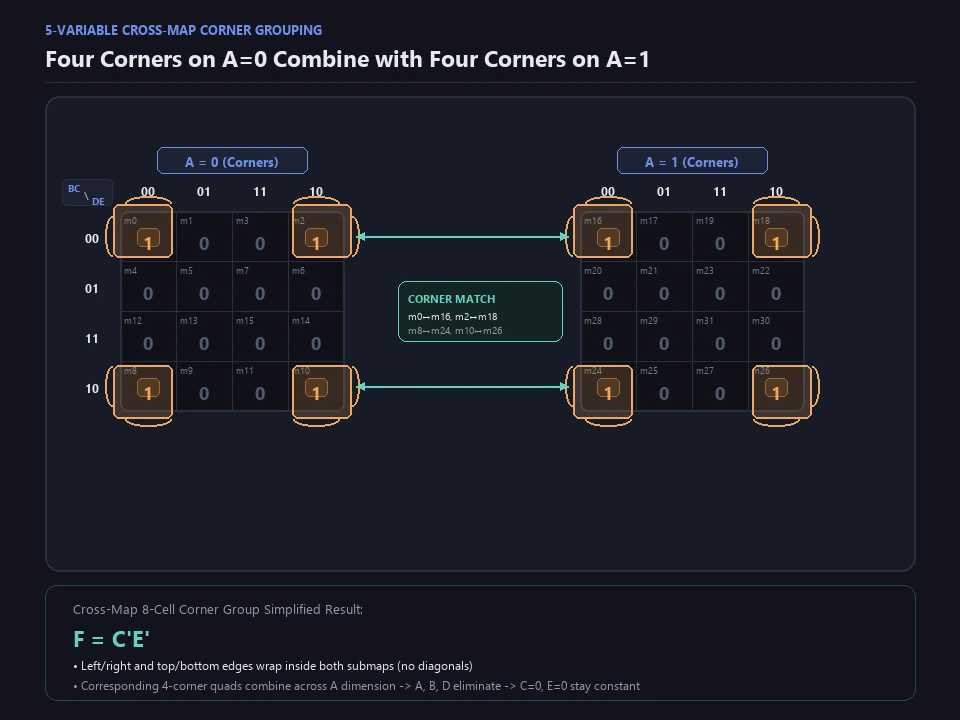
Matching corner groups on the A=0 and A=1 maps combine into one eight-cell group, leaving C and E as the only constant variables.
Cross-Map Adjacency vs Diagonal Adjacency
Cross-map adjacency works because corresponding cells differ in only A.
That is not the same thing as diagonal adjacency.
A cell cannot be grouped with an arbitrary nearby-looking position on the second map.
The BC and DE coordinates must match for direct cross-map adjacency.
What About Overlapping Groups?
Overlap remains valid.
A cell can belong to one group inside its own map and another group spanning both maps when that overlap helps produce a better cover.
As with smaller maps, overlap should serve the simplification rather than being added unnecessarily.
Don’t-Care Values in a 5-Variable K-Map
Don't-care values follow the same rules as before.
- For SOP: an X may be used like a 1 when helpful.
- For POS: an X may be used like a 0.
- Otherwise, ignore it.
In a 5-variable map, a useful X on the other map can sometimes let a 4-cell group expand into an 8-cell cross-map group.
For more detail, see the guide to don't-care conditions in Karnaugh Maps.
SOP and POS with Five Variables
The main distinction does not change.
- SOP: group required 1 cells.
- POS: group required 0 cells.
Normal wrap-around and cross-map adjacency apply to both forms.
For more detail, see SOP vs POS in Karnaugh Maps.
Common 5-Variable K-Map Mistakes
- Forgetting that five variables produce 32 combinations.
- Numbering the A=1 map incorrectly.
- Using ordinary binary axis order instead of Gray code.
- Forgetting corresponding positions across the two maps are adjacent.
- Assuming arbitrary positions across the maps are adjacent.
- Treating cross-map adjacency like diagonal adjacency.
- Forgetting ordinary edge wrap-around inside each map.
- Missing a larger valid group that spans both maps.
- Creating non-power-of-two groups.
- Forcing don't-care values into groups.
- Mixing SOP and POS rules.
A Quick 5-Variable K-Map Checklist
- Confirm the function has 32 possible combinations.
- Choose a split variable such as A.
- Build two 4×4 maps.
- Label BC and DE axes using 00, 01, 11, 10.
- Place every minterm in its correct position.
- Fill each cell with 0, 1, or X.
- Decide whether the result is SOP or POS.
- Find useful groups inside each map.
- Check the matching positions on the other map.
- Check ordinary edge and corner wrap-around.
- Allow overlap when it improves the cover.
- Derive terms from variables that remain constant.
- Verify the result against the required function.
Why 5-Variable K-Maps Are Harder to Solve by Hand
There are twice as many cells as a 4-variable map.
Adjacency now exists both inside the maps and across them.
Wrap-around relationships are easier to overlook, and a large valid group may span two diagrams instead of appearing as one obvious block.
Several valid covers can also exist.
Manual solving is still possible, but systematic checking becomes much more useful.
How to Verify a 5-Variable Result
A 5-variable Boolean function has 32 possible input combinations.
The simplified expression must match every required non-X output.
Checking all 32 combinations manually is possible, but it takes time.
You can also enter the function into the Karnaugh Map Solver and compare your manual grouping with the solver's minimized result.
Frequently Asked Questions
How many cells are in a 5-variable K-Map?
A 5-variable K-Map represents 32 possible input combinations.
How do you draw a 5-variable Karnaugh Map?
A common method uses two linked 4×4 maps. One represents the split variable as 0 and the other represents it as 1.
Why are two K-Maps used for five variables?
Each 4×4 map represents 16 combinations. Splitting on one variable gives two sets of 16, covering all 32 combinations.
Are corresponding cells in the two maps adjacent?
Yes. Matching positions differ only in the split variable, so they are adjacent across that dimension.
What group sizes are valid in a 5-variable K-Map?
Valid sizes are powers of two: 1, 2, 4, 8, 16, and 32.
Can a group span both 5-variable K-Maps?
Yes. Matching cells or matching groups on the two maps can combine into a larger group, removing the split variable.

